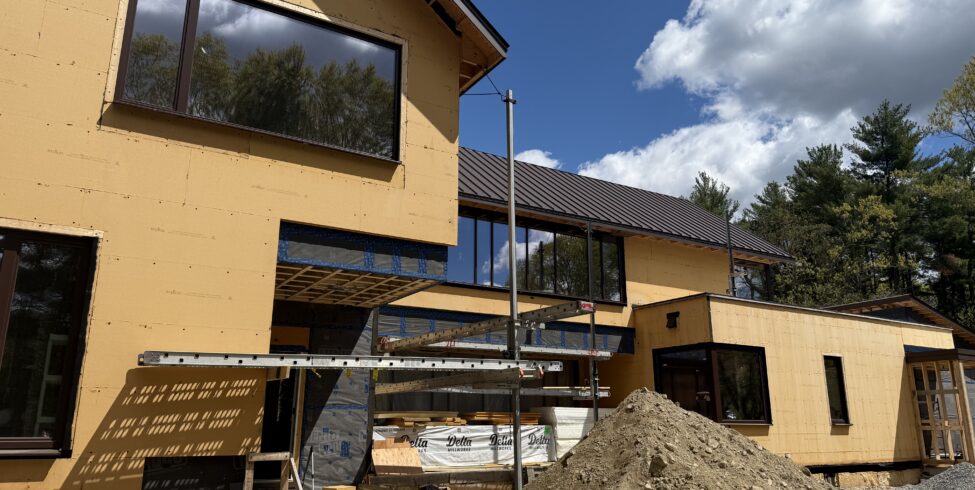
On a May morning in Lincoln, Massachusetts, a crew is fastening rainscreen battens over a wall of dense, biogenic insulation. The scaffolding is still up. The cladding has just begun to wrap the lower corner. From the access road, the building reads as an unfinished house.
But most of what will define this home’s performance is already inside the walls, and will not be seen again.
That is the working definition of building science. It is the discipline of getting the parts of a house that disappear behind drywall absolutely right. And it is not the opposite of craftsmanship — it is craftsmanship, applied to the layers no one will ever see or compliment.
The project pictured here is approximately 11,000 square feet of conditioned space across a main residence and a detached studio building. The architect is ZeroEnergy Design — known in the trade as ZED — a Boston firm that puts architects and mechanical engineers in the same studio because, as they have written, “a zero-energy building requires multi-disciplined effort.” Five of their staff are Certified Passive House Consultants. We have been working with Noah B. Fitch, ZED’s Architect and Project Manager, on the build.
The envelope
An envelope is a stack of decisions about what wraps a house, from the underside of the slab to the standing seam on the roof. On a high-performance build, each layer is chosen twice — once for performance, and again for the way it ages. The cumulative effect of those choices is the difference between a house that feels quiet, dry, and effortless to live in, and one that doesn’t.
Start under the house. The slab sits on four inches of high-density rigid insulation laid over a sealed polyethylene air barrier, on top of a washed-stone capillary break that prevents ground moisture from migrating up into the concrete. A separate two-inch thermal break wraps the slab edge, interrupting the cold path that would otherwise drain heat from the floor into the surrounding earth. The interior face of the foundation walls carries another two inches of continuous foil-faced insulation; the exterior, two inches of rigid fiberglass that doubles as a drainage layer behind a liquid-applied waterproofing membrane. Stacked up, these are the choices that make a basement floor feel warm in February, and a finished lower-level feel like part of the house instead of a forgotten room.
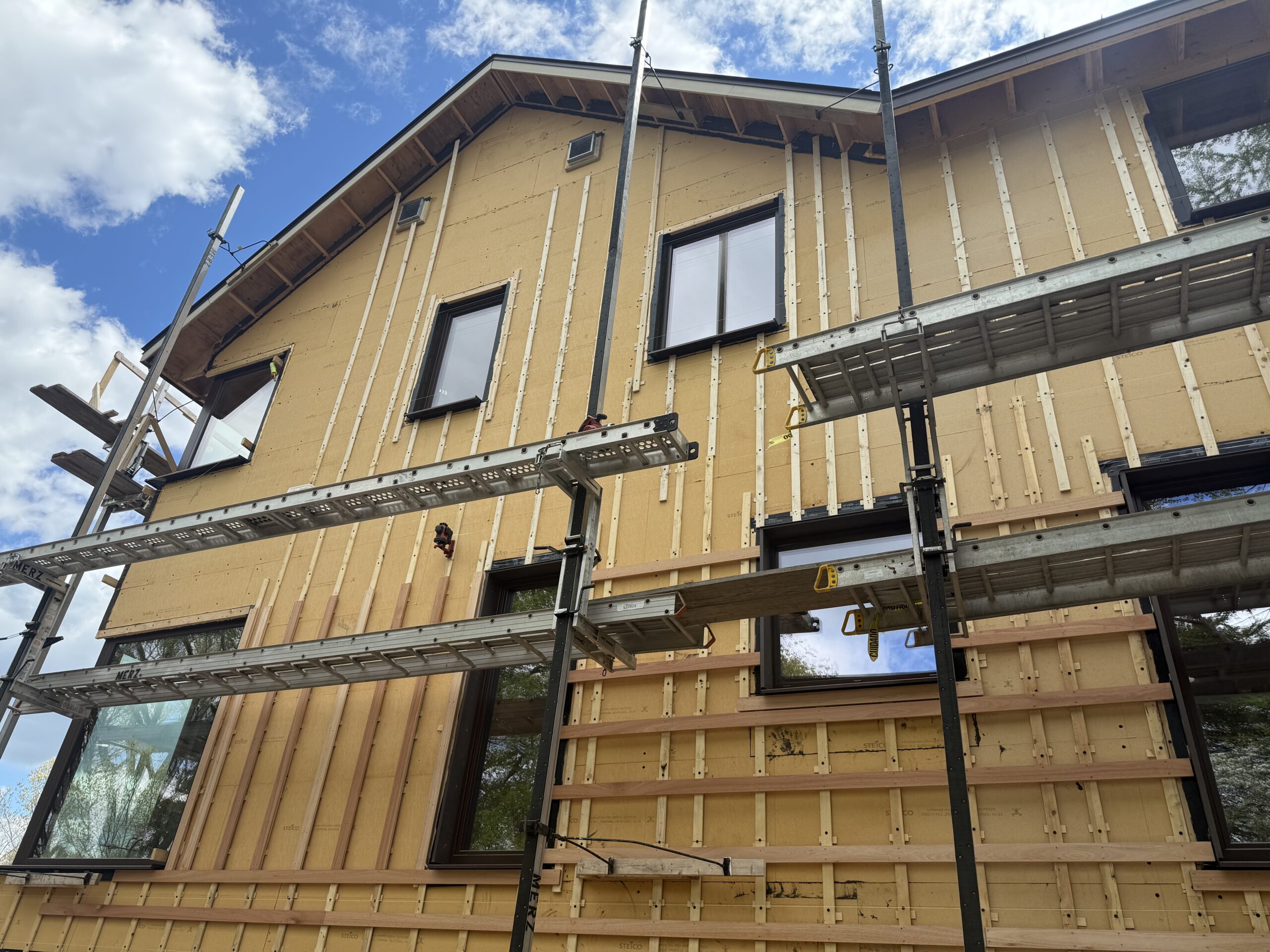
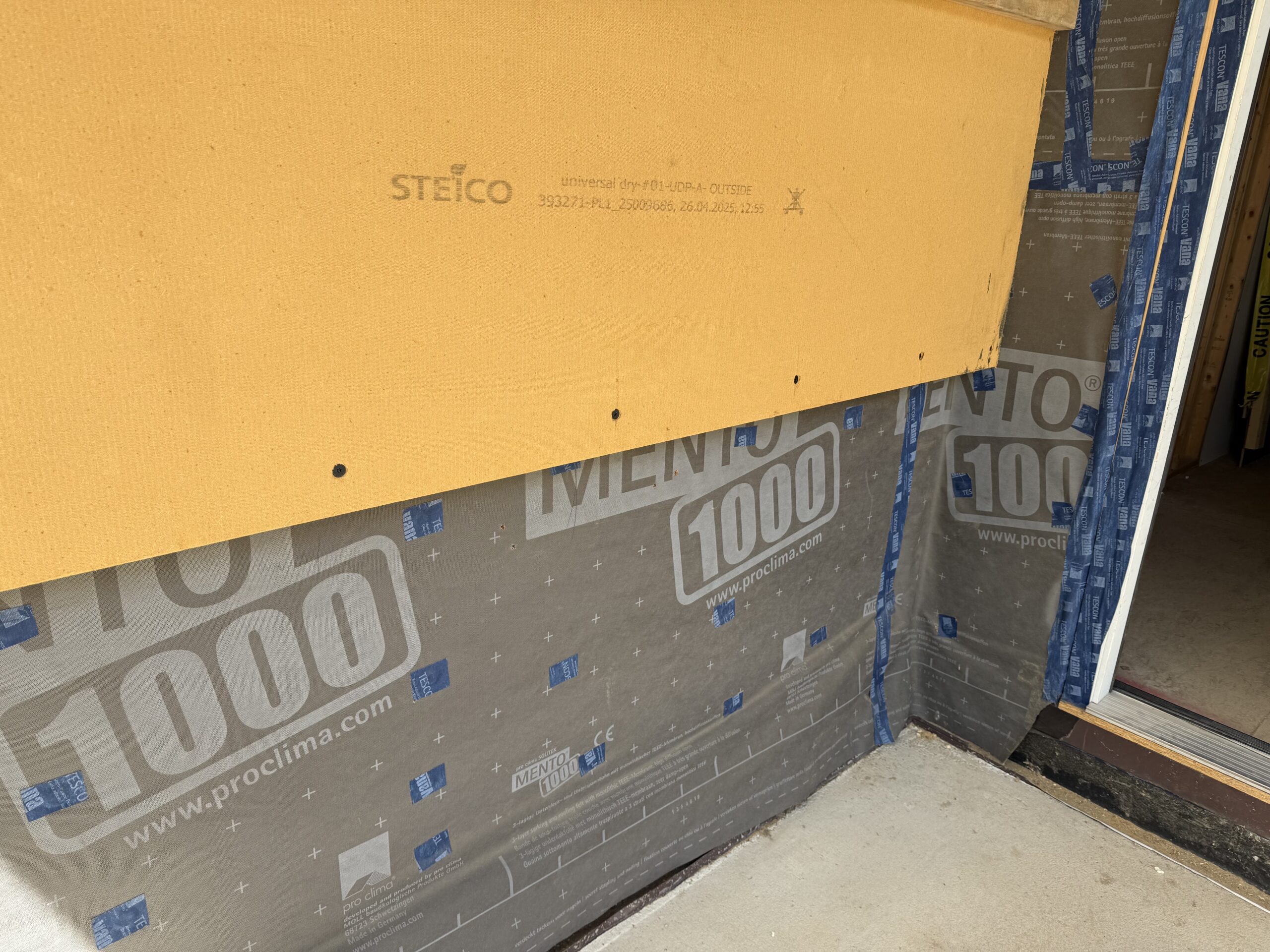
The above-grade walls run, outside in: a rainscreen cladding on cross-strapped 1×4 battens, four inches of biogenic wood fiber board as continuous exterior insulation, a European-grade weather and air barrier, plywood sheathing, dense-packed cellulose in the 2×6 stud cavity, and drywall. The wood fiber board is Steico Universal Dry — compressed softwood fiber, closer in feel to a fine particle board than to the rigid foam panels most builders use in the same slot. It is biogenic, vapor-open, and forgiving. The air barrier behind it is Pro Clima Solitex Mento 1000, a European weather membrane that breathes outward (letting moisture out of the wall) while sealing inward (against drafts and air leaks). Every corner of the building is framed as a California corner, so the insulation runs uninterrupted where the studs meet.
The roof goes further. Six inches of the same wood fiber board sit above the structural deck, with a taped air barrier underneath and Pro Clima INTELLO — a “smart” vapor retarder that responds to changes in humidity — applied to the interior face of every rafter. Above all of it sits an Englert standing-seam metal roof on a fully self-adhered, high-temperature underlayment. The attics are detailed, unvented and conditioned. INTELLO is the quiet technical heart of this assembly: it lets moisture move outward when conditions are dry and resists it inward when conditions are humid. In effect, the membrane reads the weather. The practical result is a roof that stays dry from the inside out, indefinitely.

The choice that signals the most is the wood fiber board itself. It is heavier and more expensive than the foam panels most builders use in the same slot. It is specified here for the long view. A panel that dries, instead of a panel that traps, is the difference between a wall that performs at year fifty and a wall that quietly fails at year fifteen. ZED specified wood fiber. The framing and the bulk installation of these panels were performed by Bailey & Smith. The final exterior layers — the air barrier, all of the taping, the cross-strapping for the rainscreen, and the cladding itself — are being self-performed by the Merz crew.
One detail tells the rest of the story. At every rim joist — the seam where the first-floor frame meets the foundation — the architectural notes read “Insulation @ rim joists (min. R-20), typ. No spray foam.” Most builders solve that seam with cans of expanding foam. This build doesn’t. Mineral wool and structural blocking instead. A smaller detail, a tougher install, and a tell: a builder being held to a written specification, not a builder given license to improvise.
Furniture-grade windows, and more than forty air ducts threading past them
Nine custom curtain wall units arrived this winter from European Architectural Supply in Littleton, Massachusetts — a fenestration firm that supplies high-performance European window systems to projects across New England. The units are built like fine furniture. Meranti mahogany frames with mortise-and-tenon corner joinery, no finger or splice joints anywhere in the wood. Every corner is a wood-on-wood lock built the way a cabinetmaker would have built it a century ago.
The interior is finished in Remmers #8 — a German oil that goes on by hand and reads like deep, soft, hand-rubbed wood. The exterior is aluminum-clad and powder-coated a quiet chocolate brown. The glass is triple-pane, argon-filled, separated by Swisspacer Ultimate warm-edge spacers — the European reference standard in Passive House work. In plain terms: three layers of insulating glass instead of the standard two, with a thermally-engineered spacer between them that closes off the cold edge most conventional windows quietly leak heat through. Per square foot, the conductive heat loss is roughly half that of a code-built dual-pane window. Across an envelope of this scale, with the glazing area this project carries, the math compounds significantly.

The largest of the nine units is twenty-six feet wide by eleven feet, five inches tall. A single piece of furniture, that wide.
At every window, the air seal is built in three discrete layers — an exterior weatherproofing tape, an intermediate air-sealing tape, and a third interior tape behind the trim. Belt, suspenders, and a hand on the trouser. The rough opening sill gets a layer of stretch tape underneath all of it.
But the harder story is what happens after the windows are installed. They sit through electrical, plumbing, mechanical, insulation, drywall, mudding, paint, flooring, and millwork — months of trade traffic past tropical hardwood and hand-applied oil. The discipline of protecting them through all of it — custom plywood boxing on the interior side where the work is happening, Dörken Delta breathable wrap covering the exterior surfaces, and a relentless trade-by-trade coordination so that no one parks a drill bag against a sill — is itself the work. It is unrecorded craft. And it is the part that determines whether the homeowner, twenty-five years from now, still touches a window that feels new.
The same envelope-and-protection thinking governs an even less visible system: the air the house breathes.
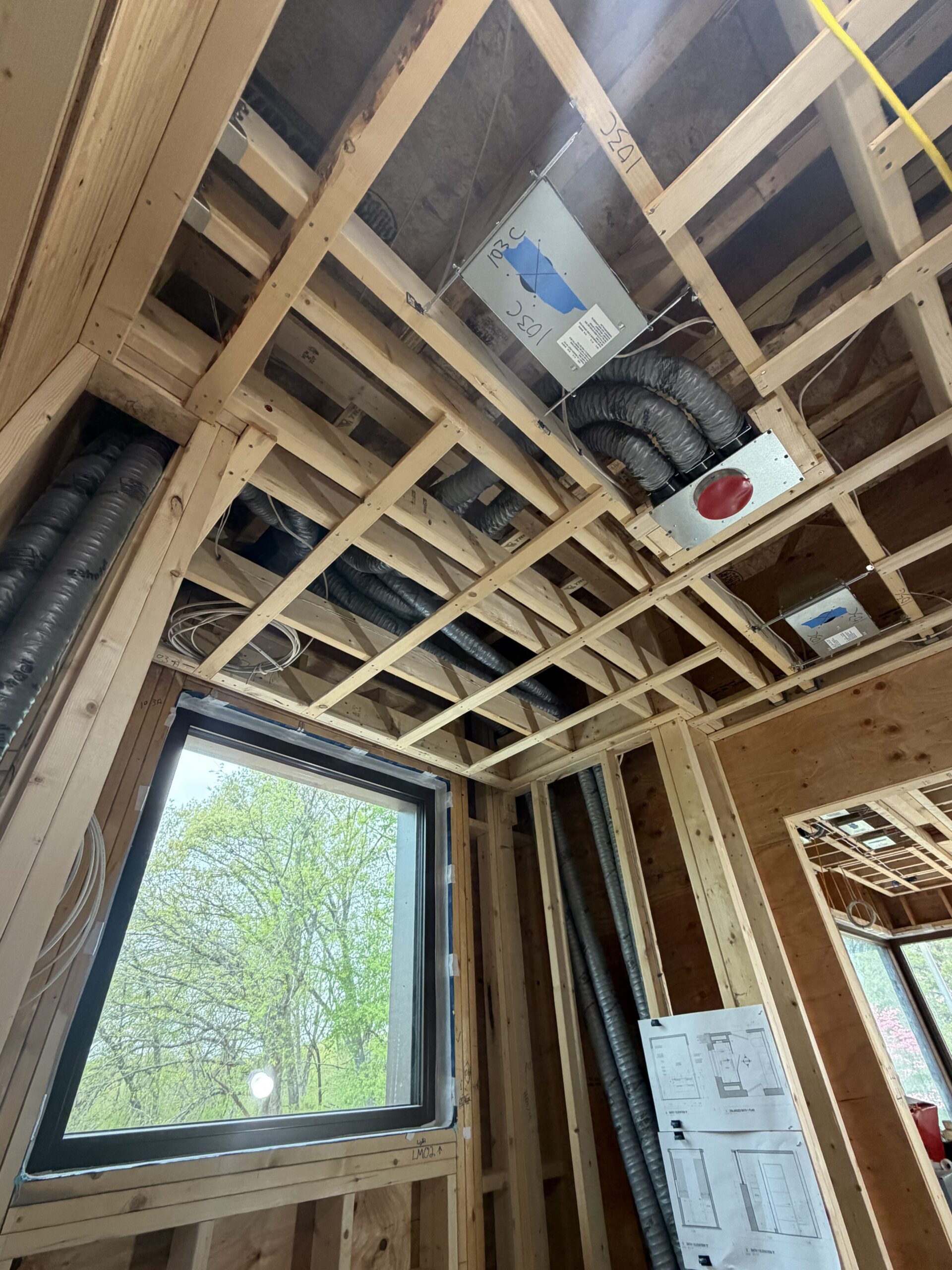
The mechanical design is by ZED. Installation is by Preferred Air. The ventilation strategy is balanced and continuous: three Zehnder energy recovery ventilators — one for the west half of the main house, one for the east, and a third dedicated to the studio building — deliver tempered, filtered, fresh air to every room of the project, around the clock. Zehnder is the European reference in residential ventilation. The units recover roughly ninety percent of the heat that would otherwise leave with exhaust air, so the home draws in continuous fresh air without paying the energy penalty most ventilation systems impose.
What that looks like in the framing is more than forty individual three-inch flex ducts threading from manifolds to ceiling and wall diffusers — and roughly eighty individual penetrations through the framing, every one a coordinated event, pre-planned in section drawings and executed in concert with the air barrier so the home’s continuous air seal stays continuous. The duct columns run in dedicated chases, occupying their own stud bays alongside but separate from electrical conduit and plumbing trunks. The discipline visible in the construction photographs — clean parallel runs, registered orientation, plan sheets taped to the framing at the work area — is what coordination looks like when it is going right.
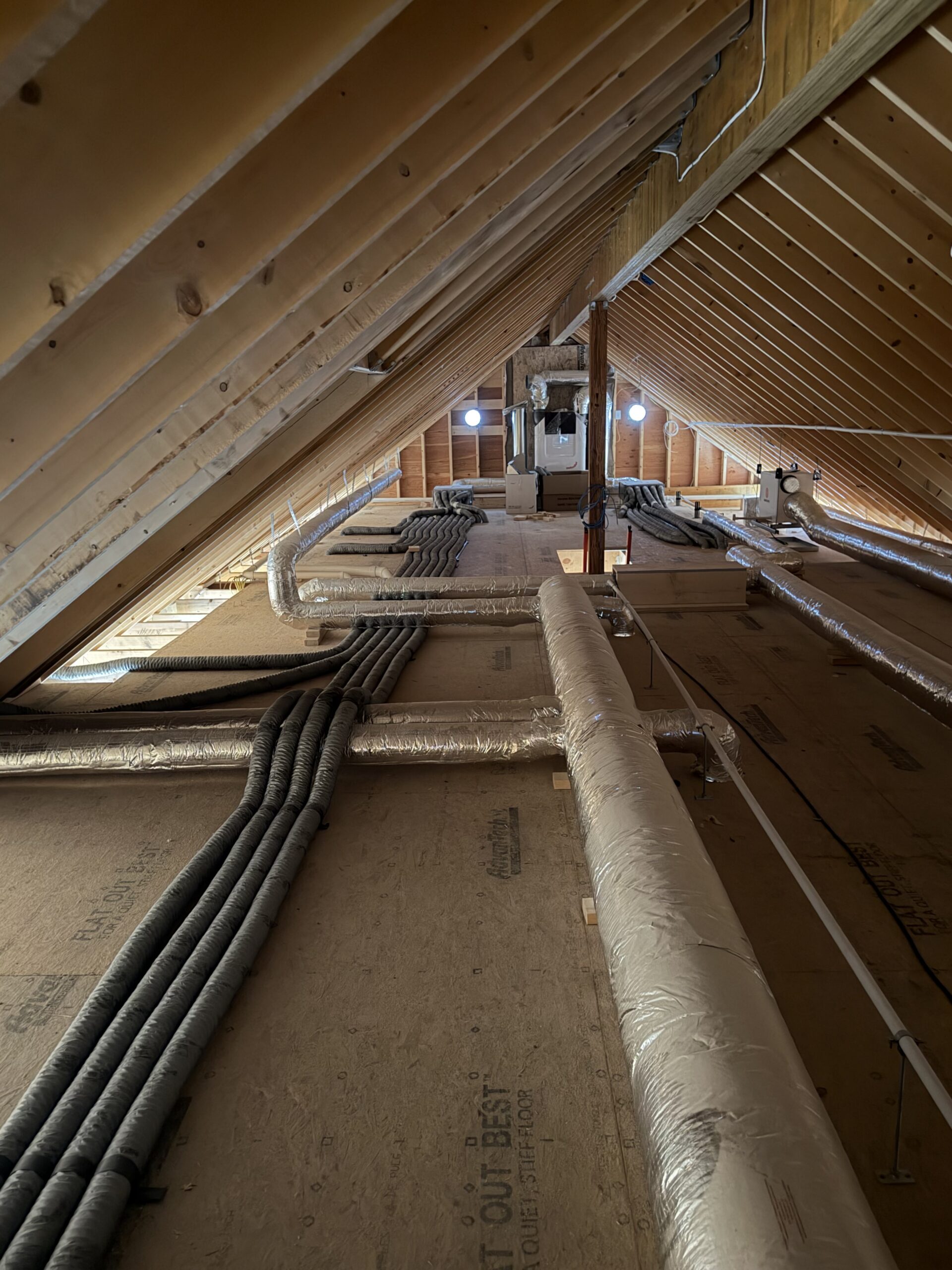
The mechanicals are all-electric. Six air-source heat pumps for heating and cooling, distributed across multiple zones. An 80-gallon heat-pump water heater. No fossil fuels for primary systems. Every air handler carries MERV-13 filtration — significantly finer than the filters in most homes. The ductwork is sealed with a zero-VOC mastic, and supply runs are wrapped in formaldehyde-free insulation. At commissioning, the entire duct system will be tested with a duct blaster, and ZED has set a hold point: total leakage may not exceed 10% of total airflow, with results submitted to the architect before any of it is enclosed in drywall. The system has to prove it works before the house is allowed to swallow it.
The craft of coordination
A continuous primary air barrier across 11,000 square feet sounds like a building science concept until you have to build it.
The principle is simple. A high-performance house must be wrapped in one unbroken air-control plane, the way a ship’s hull is wrapped in one continuous waterproof envelope. The execution is anything but. Every wall-to-roof transition, every wall-to-slab transition, every penetration for a duct or a wire or a pipe is a place the air barrier can fail. Across this footprint, those transitions run into the hundreds.
The architectural set ZED prepared for the project includes six dedicated air-barrier diagram sheets that trace the primary air barrier through every floor plan and every wall section. Most architectural sets don’t have these. ZED’s does, because ZED treats the air barrier as a building element to be designed, not an afterthought to be field-figured. On site, the tracking and execution of those details is led by Matt Hurley, Merz’s onsite Project Manager — the person whose eye on these assemblies ensures the strict specifications are met.
The tape kit on site is the evidence the spec is being executed. There are five distinct sealing tapes in use, each chosen for a specific role: a general air-sealing tape for routine seams, a specialty tape for window perimeters, two different tapes inside the three-layer window seal, and stretch tape for rough opening sill flashing. Not a builder grabbing whatever is in the truck.
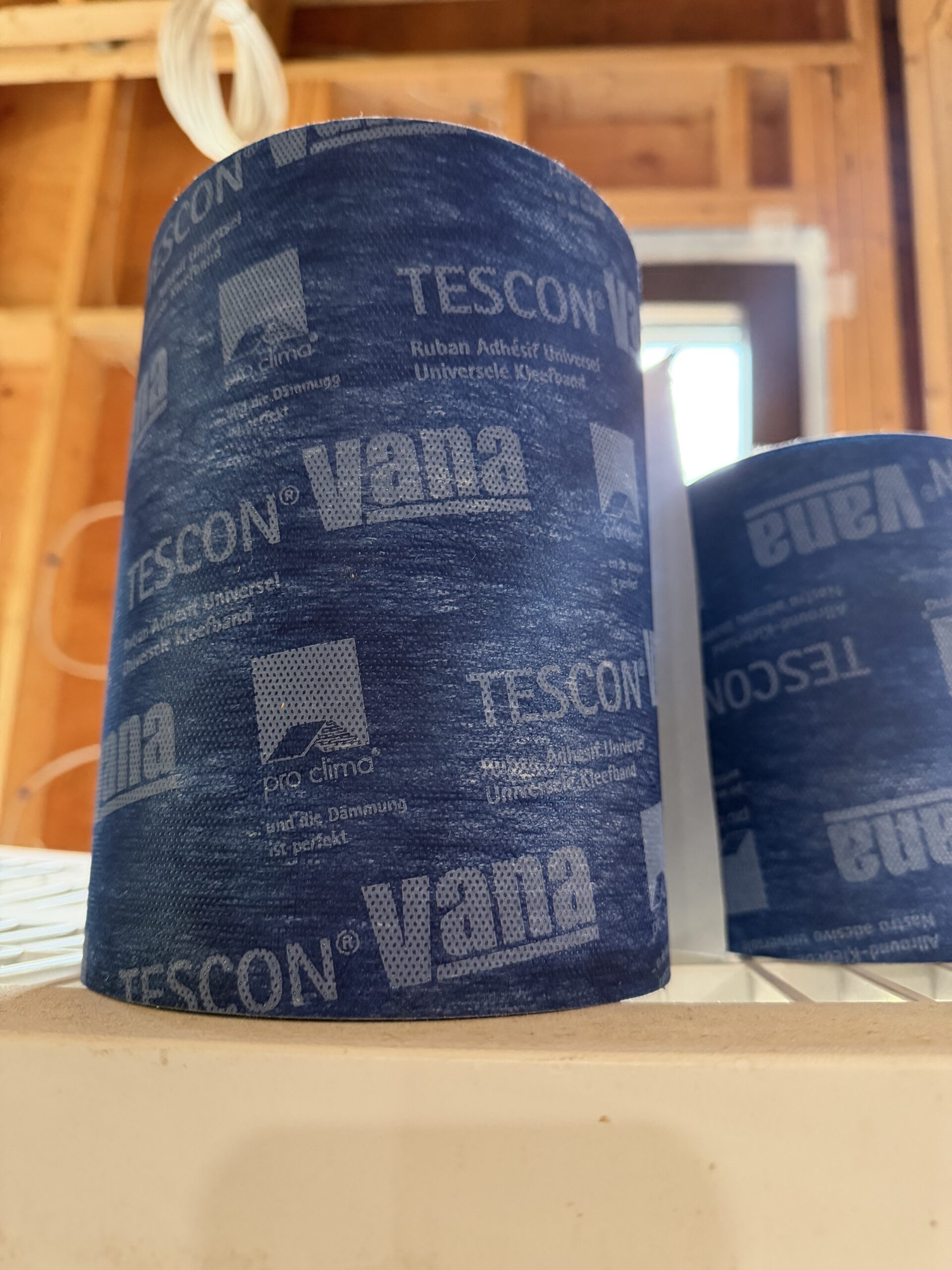
And then there is a test ZED has requested that most builders never see: a blower door test at the air-barrier stage, before the cavities are filled with insulation and before the drywall is hung.
The conventional blower door test is a final-stage certification ritual, run after the house is fully sheathed in plaster. By that point, anything that fails the test is also buried. A leak found at the end is a chase opened, a wall hole, a saw blade through the drywall. ZED’s request changes the calculus: do the test while the air barrier is still naked and accessible. A leak is something you can find, mark, and seal with another length of tape — no demolition, no rework. It is the building science equivalent of an architect’s punch-list at framing: catch the problem while it is still cheap.
It is also, plainly, an architect and a builder agreeing to be held to a higher standard than the industry default. Most builders would never volunteer for an interim blower door. This one volunteered for it.
What it means, once the homeowner lives there
Almost none of this work will be visible once the project is finished. The wood fiber panels will be behind cladding. The air barrier will be behind plywood and rainscreen. The smart vapor retarder will be behind drywall and behind cavity insulation. The ducts will be behind plaster. The mortise-and-tenon corners of the curtain walls will be behind window stops and trim.
What the homeowners will live with — and notice every day, even if they never have the vocabulary for why — is the result of all of it.
Comfort. Even surface temperatures across the entire envelope, in every season. No cold floor in February, no hot ceiling in August. None of the subtle draft-like sensations that show up at the perimeters of a code-built house. The continuous insulation and thermal mass of the slab conspire to eliminate the temperature differentials that make most homes feel breezy and uneven.
Health. Continuous balanced ventilation delivers tempered, filtered fresh air to every room of the house, all the time. The MERV-13 filtration removes particulates well below the size that triggers most allergic and respiratory responses. The duct mastic and the duct wrap are zero-VOC and formaldehyde-free. The wall cavity is dense-packed cellulose rather than spray foam — so there are no off-gassing chemicals to outlast the original installer. The house was designed to breathe correctly, and it was built to breathe correctly.
Quiet. Six inches of wood fiber on the roof and four inches on the walls give the envelope an acoustic mass most modern houses lack entirely. Add to that the silencers on the ventilation system, and you get the kind of envelope quiet you don’t notice until you visit a code-built house and remember how loud they are.
Durability. Vapor-open assemblies with intelligent membranes mean that any moisture that finds its way into the wall has a path to dry, in the direction physics wants it to dry. There are no foam-trapped wet cavities waiting to fail at year fifteen. This is a house designed to perform at year fifty.
Energy. All-electric. Continuously insulated. With a ventilation system that recovers most of the heat from the air it exhausts, and provisions on the south roof for solar panels. The utility bill will speak for itself, every month, for as long as the family owns the house.
On the team
A house this thoroughly built is the product of a team. Architecture and mechanical design by ZeroEnergy Design (Boston), with thanks to Noah B. Fitch, Architect and Project Manager, who has been our day-to-day partner on this complex build. Curtain walls supplied by European Architectural Supply (Littleton, MA). HVAC installation by Preferred Air. Framing and the bulk installation of exterior wood fiber board insulation by Bailey & Smith. The air barrier, taping, rainscreen, and exterior cladding are self-performed by the dedicated craftsmen of Merz Construction, with onsite project management led by Matt Hurley.
We will be writing more about this project as the build progresses — through cavity insulation, plaster, finish, and final commissioning — and about how a high-performance envelope changes the way every later trade works.
If you are planning a home and want to talk about what a project like this requires, from technology to the highest levels of craftsmanship, we would be glad to hear from you.